Remember that pipe bottom we had that formed the November lows? It's "possible" that we made one. I cannot say with as much certainty for this one because you can compare the volume levels between the two. If you don't know what a pipe bottom is, notice the red and white long candles in November and how they "canceled each other out". They are effective short-term reversal signals.
I am expecting to swing long this market and enter longs on any decent pullbacks. If you look at the 10-day chart, we formed a cup, and the question is "do we form the handle on it or breakdown like a dumped gf"? This is why I like to wait for a successful test of the handle, if there is one. On the breakdown, I will add shorts.
Either way, there is quite a bit of significance to the move that occurred yesterday. First, it canceled out Monday's losses. This at least gives the market some hope for a bounce. Second, the bounce occurred on the lower trend line of the DJIA's down sloping channel, the COMP bounced off of 1400, and the SPX on the 740-750 major support level. This gives added significance to the move. The downside to this? Someone can open their mouth and plunge the markets immediately.
I have no comment on Obama's speech yesterday except for the fact that there were A LOT of promises made. I don't know man...
I'll be taking it easy today due to my swollen mouth (double root canal yesterday + the 'feel good' drugs I have to take).
Wednesday, February 25, 2009


Tuesday, February 24, 2009
MARKET COMMENTARY (2-23-09)
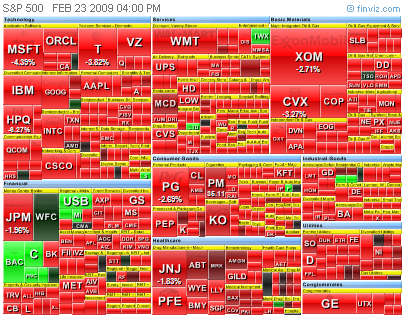
Yesterday was boring. I did make some adjustments to the existing small short positions I had and I broke even for the day despite my original thinking and despite the fact that I had a 10% BAC long position from Friday. The technicals said that we we're going to gap up and maintain momentum higher. That obviously did not happen and it shows the importance of keeping an open mind to all possibilities. I am net short with a large cash position.
I am aware that we have been down for 6 straight sessions, but know that the MSCI World index has been down 11 straight sessions, so heck, who knows, anything is possible. There are some things to note though on the individual indices.
First, the SPX closed 2 pts above the Nov low, which was 741.02. Volume indicates that we have not yet seen capitulation for all the dip buyers at the top. This sell-off is so slow and the buying is so weak that I'm questioning both sides of the market. Typically, the best thing to do is to have a large cash position available.
Second, the COMP is divergent with the SPX/DJIA and has yet to test it's own lows (Nov low: 1295.48). The volume is definitely not capitulatory and there is a lack of selling pressure. I see more downside room for the COMP, and by default, the SPX has more downside.
Third, the R2K, after the SPX, is likely to test it's own low (Nov low: 371.30) next. I also see more downside room for the small-caps.
Fourth, the DJIA is broken and it's the first that's going to the abyss. Take a look at the comparison of the 4 large bears. This makes me wonder - we may actually be starting a new primary leg down on the DJIA. It is possible and I won't rule out it. The DJIA did break and close below the 2002 low (7197.49).
Where is the selling (the fearful and panicky type)? Long investors, when are you going to puke it all out? I remember the days when we would get huge gap downs, effectively marking capitulation, and a rush of buying would come in to mark a bottom. You also had cases where there would be huge massive intraday reversals that completely wiped out all losses on huge volume days. Those are the reversals you want to be buying, not the dips on a slow meltdown.


I am aware that we have been down for 6 straight sessions, but know that the MSCI World index has been down 11 straight sessions, so heck, who knows, anything is possible. There are some things to note though on the individual indices.
First, the SPX closed 2 pts above the Nov low, which was 741.02. Volume indicates that we have not yet seen capitulation for all the dip buyers at the top. This sell-off is so slow and the buying is so weak that I'm questioning both sides of the market. Typically, the best thing to do is to have a large cash position available.
Second, the COMP is divergent with the SPX/DJIA and has yet to test it's own lows (Nov low: 1295.48). The volume is definitely not capitulatory and there is a lack of selling pressure. I see more downside room for the COMP, and by default, the SPX has more downside.
Third, the R2K, after the SPX, is likely to test it's own low (Nov low: 371.30) next. I also see more downside room for the small-caps.
Fourth, the DJIA is broken and it's the first that's going to the abyss. Take a look at the comparison of the 4 large bears. This makes me wonder - we may actually be starting a new primary leg down on the DJIA. It is possible and I won't rule out it. The DJIA did break and close below the 2002 low (7197.49).
Where is the selling (the fearful and panicky type)? Long investors, when are you going to puke it all out? I remember the days when we would get huge gap downs, effectively marking capitulation, and a rush of buying would come in to mark a bottom. You also had cases where there would be huge massive intraday reversals that completely wiped out all losses on huge volume days. Those are the reversals you want to be buying, not the dips on a slow meltdown.


Saturday, February 21, 2009
TYING YOURSELF DOWN - A PERSONAL EXPERIENCE & THE 4 STAGES OF LEARNING
Back in mid-2008, I had a friend who lost over 60%. I offered to sit next to him for one afternoon while he was trading and I made sure he was free all day. This was in early September. I told him to initiate short positions and "leave them alone for a few days". He closed out the positions within minutes. He started freaking out because aswing trade was going 5-6% against him.
I told him to re-add all the short positions. I then told him to come over to the window where a large metal pipe was running, and I handcuffed him. You can imagine how berserk he went, calling me all sorts of shit while at the same time feeling hopeless. I uncuffed him after the close. If you're thinking "What the hell am I doing with handcuffs in some dude's room", well, chill the fuck out and keep reading.
This is sort of extreme, but it's also a personal experience. Many years ago, I used to handcuff myself during trading hours to avoid impulse trading and succumbing to my emotions. If I had to go to the bathroom or eat, I had to call my neighbor to unlock me. I did this for two full weeks and it was one of my most profound experiences in my trading career. Psychologically, I had no choice but to withstand the pain and I forced it upon myself like a madman.
Now that I have students, I can't cuff them, but I tell them to completely walk away from the computer if they get urges. Since I am primarily a swing trader, I can withstand bounces and giving up large gains in anticipation of closing out trades for 20%, 30%, even 50% or more. In fact, I could be eating a sandwich and watching Youtube videos while my gains fade away because I have my trade's purpose and goal always in mind with the end result in focus. The psychological aspect of trading must be your foundation, for without it, you will not succeed as a trader.
It doesn't matter what system you trade, what programs you use, or what you subscribe to in your search for the holy grail, or "THE" answer to trading. I found that keeping it simple was the best way for me. If you notice on my daily charts, I hardly ever use technical indicators and only rely on candle charting, price action, volume, and moving averages to make an informed decision. That is really all you need to find the best set-ups that produce highly successful and high probability trades with the greatest time value of employed capital.
I use the most unconventional methods in my trading as well. Many times, I do go 100% all-in, but in the best of circumstances. I believe I will be all-in this week, switched around from long then to short, mid-week. What I do may be risky, but I am so conditioned to take calculated risks that it is second nature to me. In addition, I don't involve myself in conventional portfolio theory or asset allocation. That is a waste of time for my resources. I trade to get the biggest bang for my money in the shortest amount of time. I don't fool around with 1-2% movers. That's a waste of my day.
Everything I said above may or may not apply to you. What someone might do may not be appropriate for you and your tolerances. Most people are conservative and cannot or or are unwilling to employ the strategies that I use, all of which are 100% discretionary and technical and for some, proprietary. It is important for you to figure out what kind of trader you are, what your style is, how your personality fits, etc. This will not come overnight, but rather over months and maybe even years. You must know yourself before throwing your hard earned money in the market.
With that said, there are 4 stages of Learning:
- Stage I - Unconscious Incompetence: You have no idea what you know or don't know.
- Stage II - Conscious Incompetence: You admit that you don't know, and you want to know how.
- Stage III - Conscious Competence: You finally know how, but only if you think things through.
- Stage IV - Unconscious Competence: You fully know how and you instinctively take action.
During Stage I or Unconscious Incompetence, the trader doesn't know what's going on, and doesn't know much about trading except for the fact that you could make millions! Also, these traders have no trading plan whatsoever. In fact, they don't even know that they need one! Finally, the trader is unaware of the important aspect of trading psychology. We've all been here, done that.
During Stage II or Conscious Incompetence, the trader is all pumped up and excited about the potentials of trading. These traders look at charts all day long and flip through research reports. Finally, they open up a brokerage account anticipating great riches. This group probably reads 1 or 2 books, gets some kind of newsletter subscription, and they think they're ready to run circles around the Market Makers. Not so fast. Unfortunately, these traders lose a lot of money and they realize that all the services and subscriptions and advice they got are no use to them This is also where the individual trader gets a taste of the emotions that come with trading (fear & greed).
This is also where traders test various strategies. Stage II is especially difficult because the trader suffers disastrous losses and may become depressed or overwhelmed. His personal life may be severely affected. It is at this point that they decide to either move forward or quit trading. This is also where positive and negative judgments and thoughts are formed ("Am I too stupid to trade?, "Trading is too hard for me"). The trader has lost money, is afraid and confused, and has jumped into a financial and emotional abyss. You hear the statement, "90% of traders lose money", right? This is the stage where it happens. Even if they can afford to take the financial losses, the psychological losses are excruciatingly painful for the new trader.
When the trader makes a conscious decision to take his losses and move forward, then they have reached Stage III or Conscious Competence. Usually, traders look into the abyss and somehow make it out alive. Whatever their motivation, they decided to pull themselves out. In the process, they have also accepted a few things:
- Trading is learned until the day you die. You never stop learning.
- Whatever they did in life, how well they did in their past occupation, and their previous successes do not equate to success in trading.
- Being wealthy or being really smart also does not equate to success in trading. In fact, some of the biggest losers are doctors, lawyers, engineers, scientists, programmers, analysts, business owners, CEOs, retirees, etc. Why? Because typically, these people have this desire to always be right and for some reason, they refuse to take losses until they are annihilated.
- They cannot control the markets or "will" it to do whatever they want. More importantly, they accept that they don't need to "control the markets" to become successful in trading.
- They must have a trading plan. Seriously though, seeking advice from traders/websites/brokers/programs/ etc. as a primary method to trade is like trying to drive to Cali from DC without a map by stopping along the entire way asking all sorts of people for directions. You might end up at Sir Stanford's gf's house in Fredericksburg, VA.
- They must be psychologically prepared to trade.
Knowing where you are is important, because you now know where you need to be. Once Stage IV is reached, you must do several things:
- Create a trading plan. Goddammit. Would you start a business without a business plan? I didn't think so.
- Test out the various strategies and see what "fits". Are you a day trader, swing trader, position trader, a zombie buy-and-hold investor?
- Do not abandon any plans just because they don't work. There's always a time and place for everything in such a fluid market.
- Increase recognition and repetition. Practice, practice, and practice some more. Don't bullshit yourself.
- Accept the fact that taking losses, is part of the game. If you don't like losing, stop trading immediately. I mean it. You 'll thank me later.
- Do whatever is necessary to condition your psyche. Whatever is necessary, even handcuffing yourself.
After a while, you'll be able to understand odds and probabilities, differentiate for market conditions, learn to capture the meat of profits, scale in-and-out of positions, accept multiple & consecutive losses, learn to hold positions during heavy pressure, develop the "trader's intuition", place trades without hesitation and finally, become consistently profitable, week after week, month after month.
Hope this helps some of you out there.Friday, February 20, 2009
MARKET COMMENTARY (2-19-09)
It looks like I may lighten up on the banking short positions and add at least one unit of FAS as a hedge and also consider sprinkling in some REIT shorts. I am up slightly over +76% YTD, so my goal is capital preservation at this point, unless an absolute "can't miss" opportunity comes around. I guarantee you that there are and will continue to be massive opportunities to profit, despite the fact that we may go into/be in a depression. If you don't know how to short, then you are missing out.
I was especially disturbed by the FBI's announcement that there could be as many as 500 more cases that are either ponzi schemes or "similar-to" the ones of Madoff and Stanford and all the other retards (e.g. Sam Israel) that have already been captured, convicted, and possibly in nightmarish sexual situations. If this is true, then 2009 will not a positive year. Can you imagine hearing about ponzi schemes every week, every month for all of 2009 and beyond? It will be downright depressing.
Another thing that has come to my attention is the link between banks and drug money. Now, I just saw The International a few hours ago expecting a great movie. (Warning: Spoiler) About a third of the movie involves dozens of people shooting uzi's in a museum and a lot of people die. The ending was terrible. When I came back, this guy NDoubles tweets me this Reuters article on how drug money is keeping the banks afloat during this crisis because this money is the only liquid capital available. You can thank the drug dealers for supporting the banking system. How fucked up is that?
Technically, not much as changed on the charts, EXCEPT that I want to point out volume. Typically on consecutive down days, you want to see increased selling pressure and larger volume on the way down. This is not the case, which is the reason why I have to becareful here. Volume has remained flat forever and this is exactly something that I do not want to see. I need to see some major selling within the next 1-2 days or else I will have to cover the majority of my short positions. There is little conviction on the sell side and hardly anything on the buy side.
I continue to look at the money centers, regional banks that aren't at $1 already, and some REITs. Traditional names such as BAC, C, and WFC are preferred over GS, MS, and JPM. You want to be shorting the weakest stocks in the weakest sector, not the strongest stocks in the weakest sector. Get it? For regionals, I love STI, PNC, ZION, and BBT. Also, watch the insurers, such as HIG, MET, PRU, AFL, and PL. HIG is a lovable favorite of mine. This industry has much more room to the downside. As for the REITs, just pick a few. I like CLP, AIV, MAC, KIM, AMB, WRI, SLG, LHO and the like.
As for entering more shorts here, I don't know that yet. It depends on what develops during the day. It's almost too late to be entering a lot of stuff here. We are near the 2002-2003 bottom, so extra caution is advised in anticipation of a bounce. This is why I will not hesitate to cover or hedge at this level. Also, the Bill Miller bottom on the DJIA has been penetrated. Nice going, slick. I await your next prediction. I'm going to take it easy today (it being a Friday and all).
I was especially disturbed by the FBI's announcement that there could be as many as 500 more cases that are either ponzi schemes or "similar-to" the ones of Madoff and Stanford and all the other retards (e.g. Sam Israel) that have already been captured, convicted, and possibly in nightmarish sexual situations. If this is true, then 2009 will not a positive year. Can you imagine hearing about ponzi schemes every week, every month for all of 2009 and beyond? It will be downright depressing.
Another thing that has come to my attention is the link between banks and drug money. Now, I just saw The International a few hours ago expecting a great movie. (Warning: Spoiler) About a third of the movie involves dozens of people shooting uzi's in a museum and a lot of people die. The ending was terrible. When I came back, this guy NDoubles tweets me this Reuters article on how drug money is keeping the banks afloat during this crisis because this money is the only liquid capital available. You can thank the drug dealers for supporting the banking system. How fucked up is that?
Technically, not much as changed on the charts, EXCEPT that I want to point out volume. Typically on consecutive down days, you want to see increased selling pressure and larger volume on the way down. This is not the case, which is the reason why I have to becareful here. Volume has remained flat forever and this is exactly something that I do not want to see. I need to see some major selling within the next 1-2 days or else I will have to cover the majority of my short positions. There is little conviction on the sell side and hardly anything on the buy side.
I continue to look at the money centers, regional banks that aren't at $1 already, and some REITs. Traditional names such as BAC, C, and WFC are preferred over GS, MS, and JPM. You want to be shorting the weakest stocks in the weakest sector, not the strongest stocks in the weakest sector. Get it? For regionals, I love STI, PNC, ZION, and BBT. Also, watch the insurers, such as HIG, MET, PRU, AFL, and PL. HIG is a lovable favorite of mine. This industry has much more room to the downside. As for the REITs, just pick a few. I like CLP, AIV, MAC, KIM, AMB, WRI, SLG, LHO and the like.
As for entering more shorts here, I don't know that yet. It depends on what develops during the day. It's almost too late to be entering a lot of stuff here. We are near the 2002-2003 bottom, so extra caution is advised in anticipation of a bounce. This is why I will not hesitate to cover or hedge at this level. Also, the Bill Miller bottom on the DJIA has been penetrated. Nice going, slick. I await your next prediction. I'm going to take it easy today (it being a Friday and all).


Subscribe to:
Posts (Atom)


